Monday, December 6, 2010

Retro Cycling Jerseys originally designed for cyclists

Retro Cycling Jerseys are today one of the hottest sporty fashion trends.Although these jerseys are originally designed for cyclists, many other sports enthusiasts are using these jerseys as well. Moreover, these jerseys are even used not only for any particular sports events, but in any outdoor activity too.

Cycling jerseys are also more commonly referred to as bicycle jerseys. These are especially made for people that do a lot of biking. In fact, such jerseys are not like just any ordinary jerseys, since these jerseys are specifically designed long in the back. This is indeed very practical for cyclists since the long-back design of jerseys is for the cyclist's lower back to remain covered as he bends over the handle bar of the bicycle.

Furthermore, specially designed jerseys usually have storage pockets located at the back. Pockets for such jerseys are strategically located at the back because this keeps things from spilling, as what is most likely to happen if pockets are in front.

Although jerseys are not really required for cyclists, most especially if the environment is humid, and sweat is more likely to evaporate faster, many people still prefer using jerseys because of a number of benefits that are offered by these jerseys.

First and foremost, cycling jerseys are tight fitting. This keeps wind resistance to a minimum, which could add to the speed of the cyclist. On the other hand, tight fitting jerseys can get quite hot, most especially in humid countries. Thus, some jerseys are designed with zips at the front for ventilation.

Second, these jerseys are made of durable material. As such, even if you only have one or two jerseys for your cycling activities, you are assured that these will last longer than any of your other sports shirts combined. Aside from longevity, it is practical to buy things that will last long, at these times of financial difficulty where every purchase should be considered carefully.

Third, cycling jerseys come in many designs and styles. There is a wide variety to choose from, and the designs are just so amazing. In fact, one of the most popular designs nowadays is the retro design. Retro jerseys are printed with exiting and interesting images that add to the excitement of cycling enthusiasts.

Moreover, retro jerseys are available for both men and women. The designs are in various colors and prints that are ideal not only for cycling, but even for a night out in town. Many of these retro jerseys are available in stores online.

Finally,Retro Cycling Jerseys are made of light material that makes these jerseys very ideal for any sports and outdoor activities. Lightweight materials are necessary in any sport that requires minimum wind or water resistance, and high speed.

View Original Article

kickback hub Torker KB2

In recent years working examples of Kickback hubs that swap gears with a slight backpedal have never been particularly common, have become all but extinct from service. At one time kickback hubs were used on a number of folding and cruiser style bikes, namely for their ability to add a second gear without any cables or shifter controls. Sturmey Archer has reintroduced the technology with the S2C kickback hub, and Torker was quick to spec the hub on the complete bike, the pictured $400 retail Torker KB2. We’ve been lucky enough to have the one and only Interbike model in for review for a few weeks before production models hit shops, and I have to say that the bike is totally fun to rip around on. This is a cool bike, and the kickback hub is far more practical than than just a throw-back piece of tech to play with.

It’s a clean look, besides the coaster brake arm the KB2 looks much like your common entry-level track bike locked up seemingly everywhere these days. The frame and fork is for all intents and purposes the same hi-ten and chromoly steel construction as the single speed U-District, with a nice looking straight blade fork and a low-slung toptube given the reach for more standover clearance. It’s drilled for caliper brakes front and rear and has fender and rear rack mounts, but otherwise doesn’t have any fancy bits that should set off alarms at a $400 price point. No-name but perfectly serviceable parts make up the build, with large volume 30c tires and a chainguard being pretty on-point for the relatively short distance, casual city riding this bike is likely to see. The KB2 is no lightweight at 28lbs, no doubt helped along by the 1400g S2C rear hub.

The real story with the bike is the Sturmey Archer S2C hub, which incorporates both the shift and brake into the same back pedaling action. The shift happens just before the brake engages, meaning that you can shift between the direct drive and high-gear without applying the brake, but also that every time you engage the brake the hub shifts to the other gear. With the 42×22t gear combination of the KB2 this translates into a direct drive low gear of about 51 inches, and a high gear of 71 inches, a very reasonable and usable range and easily tunable a bit up or down with a simple chainring swap. The kickback shifting is not for everyone, and not a piece of performance oriented equipment, but it is super fun for going around town. The action takes some getting used to, but with only two gears it’s not hard to keep track of which one you’re in. In the event of braking you just need a quick second back pedal to get back into the previous gear—either way, we’re not talking a huge learning curve here. It’s easy to get used to, even if different than most anything else you’ve tried.

The coaster brake is a classic case of “it is what it is,” meaning that it works as well as expected with all the pluses and minuses of the brakes you had as a kid. Laying down a big skid is fun, long downhills requires some finesse to avoid burning out the brake, just like with every coaster brake out there.

The Torker KB-2 is an interesting choice for people looking for a no frills bike with an extra gear for when the road starts going up. Personally, I’d like to see more tire clearance, for both fenders and just in case you throw the front wheel out of true. I could see some riders desiring a front brake for added stopping power, but otherwise have no quibbles with the parts spec given the roughly $400 asking price. The frame comes in three sizes to fit most people, it wouldn’t surprise me if the bike sells well and we see it expanded to the six sizes available for the U-District. Available soon at shops, I suspect this is going to be a popular model this coming season.

View the original article here

Saturday, December 4, 2010

Chris White high expectations for 2011 Season

Chris White has high expectations for 2011 Season.The Professional Continental outfit Pegasus Sports welcomed its 20-man roster, which includes eight riders who raced for the Continental team Fly V Australia this year, to an opening meet and greet held in Noosa, Australia this week. Team Manager Chris White assured that the riders who have upgraded from the Continental team are eager and equipped to handle the higher level of competition that the will inevitably face in major international events during the 2011 season.

"We got here yesterday and it's going well," White told Cyclingnews. "It is the first camp for the year for the Professional Continental team. The purpose of the camp is just to get to know everyone and we have a significant number of new faces in the group. We are here to get our first lot of equipment and to get to know each other. We've done some good activities and some surfing which was good fun. We are here for one full week. So much of cycling is about teamwork and having strong relationships around communication, that's paramount."

The eight riders that have stepped up from the Fly V Australia Continental team into the Pegasus Sports Professional Continental program include Australia's Ben Day, Bernard Sulzberger, Jonathan Cantwell, Aaron Kemps, Jai Crawford and South Africa's Darren Lill and Jay Thomson along with one American, Phil Zajicek. Those riders will have the rare opportunity to learn from veteran racers like Robbie McEwen and Robbie Hunter.

"Some of the guys have mentors and are going to be racing with teammates that they can talk to and learn from," White said. "I think making that step up and learning is a big part of our structure that we have set in place. We are in a position now where those eight guys have some breathing room because we have brought on some great riders who have a lot of European experience and success from the pro peloton already. That will take some pressure off of those riders who are coming from Fly V Australia but we are still expecting some good results throughout the course of 2011."

The eight riders were offered upgraded contracts based on a successful season in 2010. Some of the highlights include securing for Fly V Australia the National Racing Calendar (NRC) overall team title via winning performances at the Redlands Bicycle Classic, Tour of Somerville, Tour of Elk Grove, stages of the Tour of Utah and the Presbyterian Invitational Criterium along with the non-series event Tour de Beauce. The team also displayed a strong performance at the Amgen Tour of California where Zajicek place tenth overall, multiple top ten stage places and a solo attempt at victory from Day on stage five into Bakersfield.

"We've certainly taken a step up as we've gone from the US program to the blow torch that can be Europe," White said. "I think if you look at how the team performed at the Amgen Tour of California, the stats show that that event was equally as difficult if not more difficult than some of the Grand Tour stages, although not as long. Phil Zajicek and Jonny Cantwell got a couple of top fives and the team rode the front all the way to Bakersfield, Ben Day almost won a stage this year. I think that the guys are more than capable of making that step up and they've demonstrated that on the road over the last couple of years. We had a great season this year and we are expecting to carry some of that momentum into 2011. They guys are all capable."

According to White, Pegasus Sports will have some presence in the US racing scene with a focus on garnering an invitation to the Amgen Tour of California in May and the TD Bank International Cycling Championships held in Pennsylvania in June and the Quiznos Pro Challenge held in August in Colorado. In the USA, the team is only be eligible to compete in UCI-sanctioned events according to UCI code 2.1.009.
"The team will racing in the US but the program has not been finalized yet," White said. "It will be very competitive to get a race start at the Amgen Tour of California but we would love to be there with our squad. It has been a really great race for us to do in the States and we would love to continue to do so."

V Australia continues as a Continental team with nine new riders

The Fly V Australian Continental has signed four returning riders and nine new riders for a 13-man roster. The roster will be announced at a later date. White noted that the team name has dropped the Fly and will now be known as V Australia Pro Cycling Team.

"We are not using the Fly anymore because we want more people to understand that our branding is the airline," White said. "I will say that the team will be led by a former Australian road cycling national champion who is new to this squad but he is coming from another Australian cycling team.

"The race program is going to have a really similar look and feel to the team that we have had in the US," he said. "Those riders have some big shoes to fill because our results this year in the US have been great. But the talent we've got lined up for the squad is capable of picking up where we left off."

The V Australia Continental team will focus on NRC and USA Cycling events. However, all domestic teams must register with USA Cycling if they want to factor into the overall team standings. The rule states, "All domestic elite teams will be required to register rosters with USA Cycling in order to be calculated in the NRC team standings. This will facilitate a clearer representation of the team points standings. (Individuals will be able to gain individual NRC points as in previous seasons.)"

V Australia will also contest several overseas races beginning in Asia at the Tour of Korea. "We have enough racing that we will not send two teams to the US," White said. "We are requesting some race starts outside of the US for V Australia. However, the team will be a predominantly US-based racing program."
Follow Cyclingnews on Twitter for the very latest coverage of events taking place in the cycling world - twitter.com/cyclingnewsfeed

View the original article here

Friday, December 3, 2010

Going around a corner on two wheels

Some will say that the science of going around corners is, if not straightforward, then well-understood; all that stuff about corner radius, G-force, coefficient of friction, lean angle... there's plenty of maths out there to deal with it. Trouble is, actually going around a corner, especially on two wheels, is more of an art, or we'd all be able to do it equally well. Which, when one spends any amount of time watching footage of Fabian Cancellara, is surely not the case.

Of course, going around corners is something all cyclists (except trackies...) do on every ride, so it's not exactly an alien concept. It's just that most of us don't generally go around them any where near as quickly as we might or even as we would like to be able to. And what's stopping us? Confidence.

Or maybe not. My first cycling crash (and many more since) involved entering a corner way too fast and finding the wheels slide out from under me. Others, less painfully, have involved entering a corner too fast and, anticipating the slide, heading for and ending up in whatever lay around the outside. Either way, lack of confidence was not the primary issue. But that's a personal failing. Others may find they lack the confidence to enter a corner fast and exit having concluded they could have gone faster.

If only there was a way to ascertain just how fast is feasible. One such, and surely the most reliable, is to go around the same corner time and again, taking it a little faster each time until the limit of tyre grips is reached and the rider either gets a slide and recovers it or gets a slide and falls off. This is fine on a circuit and explains why it is possible to reach extreme lean angles in a criterium or circuit race.

Out on the road, where each corner is either new or encountered for the first time that day, such aggression is likely to end in the ditch. And yet some riders still safely get around quicker than others. To do so they need, not simple lack of concern for personal safety, but the ability very quickly to gauge available grip, to visualise a line through the bend ahead and to judge how fast the available grip will permit the line to be followed.

Grip, of course, is the key. And it changes from day to day and even from hour to hour, which means it must be appraised anew for each bend. Perhaps the least enjoyable long ride I have ever done was from Llucmajor back to Pollenca across Majorca in a rainstorm. The roads on the island are like wet marble in the rain and, even on long straights, there was a constant sensation of sliding around. Every corner, no matter how gentle, was a terror. But, by going very steadily indeed, all but one of our group got back without falling off.

How, then, is it possible to discern how much grip is available? Let's assume that the bend in question is to be taken at a speed slower than that along the straight preceding it. The rider will have to slow down and, in doing so, will get a feel for available grip from the tyres under braking. Next comes the moment of turn-in, which itself requires countersteering. At this point it may become clear that the anticipated line is too tight and a wider one must be taken; in any case, grip must be determined before committing to a line.

Experience, of course, plays a big part in assessing grip, but it is possible to speed up the acquisition of experience on various road surfaces by practising, especially with braking. Assessment of line should come quickly to anyone interested in developing it. Look for a wide entry leading to a defined apex with a clear, obstacle-free exit. Bear in mind that a downhill bend on a bicycle will accelerate rider and machine while a flat bend will slow them down and that the line followed through them will differ in detail. But, with practise, it is easy enought to gain an eye for a good (if not the perfect) line.

So, at its most basic, going around a corner quickly and safely involves entering it on a good line at a speed at or just below that permitted by the adhesion between road and tyres. Key to the former is the ability to pick out the entry point, apex and exit line, while key to the latter is the development of a feel for grip at the moment of corner entry, which itself is gleaned from braking prior to the bend. Assuming the amount of grip stays the same up to it and all the way through...

View the original article here

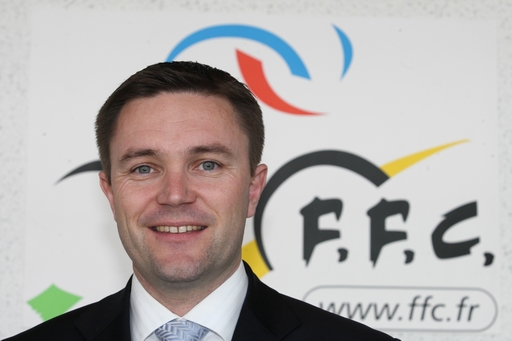
David Lappartient has spoken out against the organiser of the Tour de France

David Lappartient has spoken out against the organiser of the Tour de France (ASO) and pointed out problems in the management of pro cycling, whether in France or abroad.The French cycling federation (FFC) president Speaking to newspaper Le Monde on November 25,explained the current dispute between the FFC and ASO regarding the payment of insurance fees, as well as calling for team managers to face doping suspensions in the future.

Lappartient had chosen not to attend the presentation of the 2011 Tour de France in October because of the disagreement. "We started negotiations with ASO to have the organisation contribute fairly to the federation's insurance contracts. At the moment, this is not the case. We started talking in October 2009 but since then, the process has stalled," said Lappartient, pointing at the higher accident risks at the Tour de France and the subsequent raise of insurance fees.

"It's a fundamental problem because it's amateur cycling that is currently paying the insurance for the Tour de France," he explained, adding that a general rift had started dividing amateur and professional cycling. On one hand, the FFC has never had as many members as in 2010, and on the other, there will be only one French team automatically admitted to the UCI World Tour events next year, AG2R La Mondiale.

"France is the 14th nation world-wide in men's road cycling. We had five teams in the ProTour four years ago, and we lost one every year. Pro cycling should help amateur cycling, because the Tour de France needs to prepare tomorrow's champions. It's been 25 years since a a Frenchman last won this race, we have never lived such a drought! But since finance has taken over the power, some subjects are not a priority," the FFC president continued. "There needs to be greater solidarity between the different families of cycling."

 "Within the Junior and the Espoir ranks, we have very good results: we are amongst the three best nations world wide," said Lappartient, who evoked doping, excessive payroll charges and a certain lack of ambition as some of the factors that have led to this situation.

"Doping has played to the disadvantage of the French, who have made ethical efforts that other countries have not always made. Moreover, you have to pay 30 to 40 percent more to create a team that is one the same level than abroad, because of heavy payroll charges. We are amongst the last countries to have professional riders that have employee status within their teams, contrary to being free-lance.

"Finally, we have too much of a French approach: our riders want to do the Tour de France and shine at the national races, more than achieving results in the big races of the international calendar. The French sometimes lack ambition: some riders just settle for a pro contract and don't necessarily have further aggressiveness."

Lappartient continued to explain that the ProTeam system of the UCI is not the only factor to blame. "It's a vicious circle: the less teams we have at the top, the less points we'll score at the races. You have to take into account the international dimension of cycling. Our calendar is very developed and may satisfy the French, but we shouldn't settle for competition amongst ourselves."

Doping suspensions for team bosses?

Finally, Lappartient called out for a more radical approach with regard to anti-doping. Even though "considerable efforts" are made within the sport, the Frenchman would like to see doping bans extended to the teams' management level.

"I think that we have to fire an important part of the team managers on an international level. When I see that some team recruit riders like [Riccardo] Ricco or [Ezekiel] Mosquera, I can only say that they have not understood a thing. Somebody like Kim Andersen, who - even if his suspension was lifted - was banned for life for three positive controls, has found a team again! It is our duty to set an example."


Follow Cyclingnews on Twitter for the very latest coverage of events taking place in the cycling world - twitter.com/cyclingnewsfeed

View the original article here

Thursday, December 2, 2010

Triathlon Plus Ridgeback Flight


The  Triathlon Plus Ridgeback Flight range now extends from the £2,299 Flight Ti to the 01 at £529.99, with the quick-witted 03 in the centre.It’s de?nitely better-suited to con?dent riders on smoother roads than nervous novices and regular cycle path users.The Triathlon Plus Ridgeback it was one of the first brands to develop a  bar road bike/high performance hybrid. 

Ride & handling: Sharp steering gives snappy responsiveness but may worry inexperienced riders

A ?rm ride is the immediate – and lasting – impression of the Flight. The full size (rather than compact) frame is surprisingly stiff despite relatively slim tubes. That means a sharp, clean feel on smooth roads, but a fair mount of rattle on rougher surfaces. The ?rm saddle and grip contact points don’t take prisoners either and you’ll certainly want to steer clear of any signi?cant potholes or kerb edges if you want to avoid a serious stinging.

The handling character set up by the long top tube, quick angles and the narrow, dead-straight bar is certainly an acquired taste too. If you’re a con?dent rider the lack of width is great for diving between gaps in traf?c or going straight through anti-moped gates on cycle paths. It makes the steering very snappy and nervous until you’re used to it though, which isn’t ideal for novice commuters or slippery winter roads.

The powerful disc brakes might catch you out the ?rst few times too, but offer clear advantages once you’re used to them. The long top tube and narrow saddle are welcome features on longer, faster rides, giving plenty of breathing space and a rub-free rump. Once the you’ve got the weighty wheels rolling, the Flight 03 holds speed well over smooth surfaces, with the quick steering enhancing the feeling of speed and spark.

The race rather than recreational ratio rear cassette means you’re not likely to run out of gears, even if you add some maximum effort sessions – although the steepest streets will de?nitely be a struggle. Acceleration is de?nitely not as rapid as the best of the Ridgeback's rivals. Despite an extended alloy dropout to support it we also had to adjust the front brake carefully to stop it rubbing on the rotor when we were out of the saddle.

Frame: Surprisingly stiff, despite relatively slim tubes; carbon fork is a bonus at this price

The full-size (rather than compact) steel-grey frame looks understated, but it ticks all the SUV boxes. The tall conventional head tube gets a strengthening gusset just in case you stick the front wheel into a big pothole. Main tubes are triple-butted to save weight without losing strength too. The seatpost slot faces forward to stop salty winter wheel spray seeping into the frame and seizing everything solid, with a neat bolted clamp collar up top.

Twin bottle cage and rear rack mounts mean the Ridgeback is ready for longer rides with commuting or exploring cargo on the back. There are bosses for conventional mudguards or a Crud Catcher style mountain bike 'guard and the disc-speci?c frame means no ugly redundant brake studs either.

Despite ‘same as the frame’ appearances that’s a multi-pro?le carbon-legged fork hiding underneath the paint (not an alloy one) too. While the conventional rather than sloped top tube means taller straddle heights, no fewer than ?ve frame sizes mean everyone can ?nd a ?t.

Equipment: Road bike kit and tight gears translate well to training; narrow bar won't suit everyone


There are some parts of the kit ?t that won’t agree with everyone. The most obvious one is the narrow, totally straight ‘courier’ style handlebar. The mixed central mound and rough diamond grips are best handled with gloves too on rougher or longer rides. While they’re heavy, the Shimano hubs run for years with regular bearing maintenance and the Duraskin tyres are fast for reinforced rubber.

The Shimano disc brakes need a careful hand not to lock the wheels up, although the consistently high control in all weathers is a major bonus on busy roads. Disc brakes are legal for all cyclo-cross races now too, so you won’t get grumbles if you switch tyres and show up at your local park grand prix this winter.
Otherwise, the Flight is running on a mix of proven Shimano road kit, with a narrow ratio cassette and compact chainset giving plenty of top-end speed, if limited lower gears. The narrow saddle also lets you know you’re on a performance-oriented machine.

View the original article here

Wednesday, December 1, 2010

Niels Albert remain dedicated to cyclo-cross

Following recent speculation that Niels Albert 'cross rival Zdenek Stybar (Telenet-Fidea) is on the verge of converting to the road with ProTour squad Quick Step,Niels Albert (BKCP-Powerplus) has expressed his satisfaction with a decision to remain dedicated to cyclo-cross.  

Albert had himself contemplated a switch to road early this year during a frustrating period of the 2009-2010 season, but last month confirmed he will continue to race on the European cyclo-cross circuit until at least 2014 after signing a three-year contract with BCKP-Powerplus.

The 24-year-old Belgian preceded Stybar as cyclo-cross world champion in 2009. Despite only earning one win thus far this season, Albert is treating the speculation swirling around his Czech rival as a blessing for his chances of re-capturing his 2009 form.

"If things remain uncertain for him [Stybar] for a couple of months, then that's going to take its toll for him mentally. I would find it really annoying to be in that position," said Albert, according to Het Nieuwsblad. "I doubt I would be able to perform at my best, because certainty is really important for a rider."

Stybar, 24, has continued his domination of the European 'cross scene this year winning the first two rounds of the 2010-2011 World Cup series and trading wins in the Superprestige and GvA Trophy series' with Sven Nys and Kevin Pauwels. However, despite his performances in the rainbow jersey, the Czech star admitted this week that contract negotiations with his current team Fidea-Telenet had stalled and that he had subsequently received a contract offer from Quick Step which would give him the opportunity to race the Spring Classics on the road and potentially race the cross-country mountain-bike race at 2012 Olympic Games.

That news was followed on Thursday by the announcement that Czech billionaires Zdenek Bakala and Bessel Kok had purchased a majority share in the Belgian ProTour squad. Stybar's profile both in his native Czech Republic and Belgium would make him an ideal acquisition for the squad.

In contrast to the fanfare surrounding Stybar's proposed move to Quick Step Albert described the comparatively nature of his own recent contract negotiations with BCKP-Powerplus sports director Christoph Roodhooft.

"I got a telephone call from Christoph in the morning while I was out training," he said. "He asked me 'Can you come past and see me? Because there a contract is ready for you.' I stood there, with the railway in earshot. I asked to Christoph what he would ask, and he made me a proposal.

"I rode past to see him in Morkhoven, came in along the backdoor, and signed the contract with a pen from Aldi. We didn't drink any champagne because five minutes later I was back out training."

Despite having taken pause to consider his options for a career on the road in January, Albert indicated his contentment with the decision to remain true to his cyclo-cross roots. "After I signed the new contract I spoke to my mother and my girlfriend, and both said the same thing to me: 'If you are satisfied in that team and with the offer, then you must do that.' So far I have no regrets."

Follow Cyclingnews on Twitter for the very latest coverage of events taking place in the cycling world - twitter.com/cyclingnewsfeed

View the original article here